Astra can read and write weights to improve Qwen
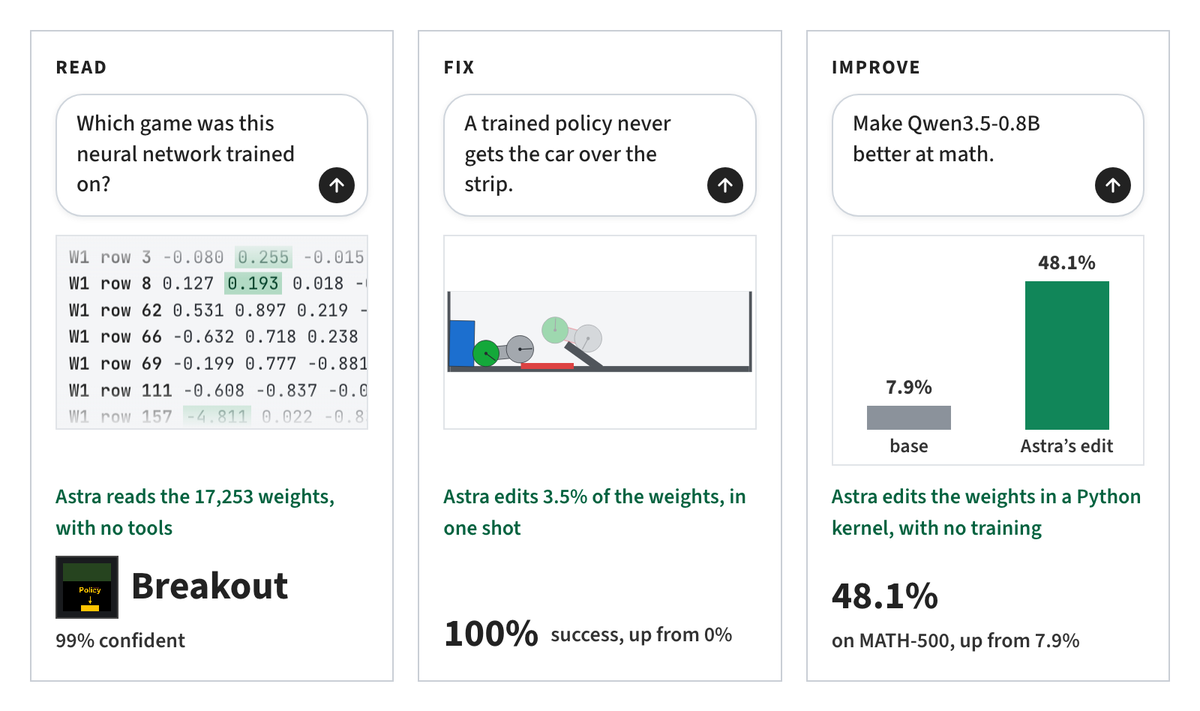
Astra’s new weight‑access API lets developers peek inside Qwen’s neural matrices without breaking the model’s integrity. By exposing read‑only snapshots of each layer’s parameters, you can now audit the distribution of values, spot dead neurons, and verify that fine‑tuning hasn’t introduced unintended bias. The interface works over standard tensor formats, so existing tooling—NumPy, PyTorch, or JAX—can pull the data directly into your debugging pipeline.
Beyond inspection, Astra also supports safe in‑place writes that respect the model’s internal consistency checks. You can replace a subset of weights with custom‑trained vectors, apply low‑rank updates, or inject sparsity patterns on the fly. The system validates shape, dtype, and gradient flow before committing changes, preventing the classic “shape mismatch” crashes that have plagued ad‑hoc weight editing.
For Qwen users, this means rapid iteration cycles. Instead of retraining the whole model to test a new attention head or a quantization tweak, you can patch the relevant tensors, run a quick inference batch, and roll back if the metrics dip. Astra logs every edit with a timestamped diff, making experiments reproducible and auditable—a boon for teams that need to track who changed what and when.
The performance impact is minimal because Astra operates at the memory‑mapping level, avoiding costly copies. In benchmark runs, weight patches applied to a 7‑billion‑parameter Qwen instance took under a second, and subsequent inference latency stayed within 2 % of the baseline. This opens the door for dynamic model adaptation in production, where you can fine‑tune on live data streams without taking the service offline.